Nov 19, 2026
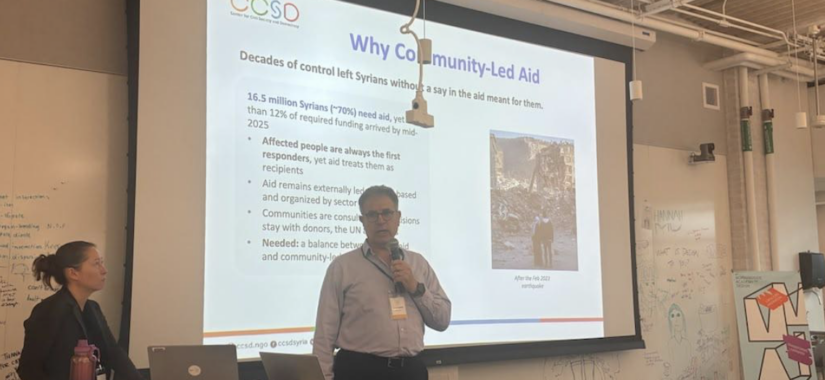
CCSDS’s Grant Manager and Policy Advisor Ali Aljundi at the Center for Civil Society and Democracy in the USA (CCSDS) participated at the two-day Forum on Community Engagement and Participatory Design in Humanitarian Innovation and Disaster Response at the Massachusetts Institute of Technology (MIT) in Cambridge, Massachusetts, on November 12–13, 2026. Speaking to an international gathering of researchers, designers, practitioners, humanitarian organizations, and people with lived experience of displacement, Mr. Aljundi presented CCSD’s practical work on applying Humanitarian-Development-Peace nexus using the Survivor and Community-Led Response (sclr) approach in Syria.
Rethinking Humanitarian Innovation
The forum was jointly organized by a coalition of leading academic and humanitarian institutions: Boston University’s Center on Forced Displacement, MIT D-Lab, MIT’s Urban Risk Lab, the Japanese Red Cross Disaster Management Research Institute, and Red Social Innovation (French Red Cross).
Convened against a backdrop of escalating global crises and shrinking humanitarian funding, the forum’s overarching theme centered on closing aid gaps by making humanitarian innovation more culturally and contextually grounded.Building on commitments made since the 2016 World Humanitarian Summit, the event served as an open platform to move humanitarian aid and disaster risk reduction away from top-down delivery and toward participatory design, co-creation, and long-term communities of practice.
Putting Syrian Communities in the Driver’s Seat
During his presentation, Mr. Aljundi highlighted a fundamental gap in traditional humanitarian aid: while local communities are always the first to respond when a crisis hits, they rarely have a say in how aid is designed or distributed.
He demonstrated how CCSD’s implementation of the sclr methodology flips this dynamic. Rather than imposing external projects, sclr identifies existing local and mutual aid groups that are already supporting their neighbors, backing their self-designed initiatives with small, flexible micro-grants. Guided by the Appreciative Inquiry 5-D cycle (Define,Discover, Dream, Design, and -Delivery ), this approach builds on a community’s existing strengths and vision rather than focusing solely on deficits.
Mr. Aljundi also spotlighted the SY-sclr Collective, a pioneering consortium of 12 Syrian civil society organizations and mutual aid groups that collaboratively govern and decide how a shared fund is allocated across communities.
“The innovation is in who decides, not in technology. When communities lead, recovery starts sooner and reaches further.”
— Ali Aljundi, CCSD Grant Manager and Policy Advisor
Participating in this forum underscores a core pillar of CCSD: strengthening Syrian civil society so that local actors are recognized not merely as beneficiaries or implementing subcontractors, but as primary decision-makers in peacebuilding and recovery. Engaging with global pioneers at MIT and the Red Cross network validates that the governance models tested by Syrian communities through the SY-sclr Collective offer vital lessons for the broader international humanitarian sector.
Participants concluded the two-day exchange celebrating shared insights on community-led design, expressing strong interest in how CCSD’s model of identifying genuine grassroots initiatives and sharing funding governance can be adapted to other protracted crises worldwide.