Center for Civil Society and Democracy CCSD has been a partner of the MBBI, supporting women in Syria with training, and negotiation support which started in 2013. At MBBI, we begin with creating spaces and platforms for the voices of those at the heart of the conflict, the proximate peacebuilders.

Since the beginning of the Syrian revolution (2011), Syrian women, youth and civil society have played a crucial role in the fight for peace and democracy by participating in demonstrations, delivering humanitarian aid, supporting the survival of local communities, supporting the education and health sectors, and fighting ISIS. Throughout the last 14 years, Syrian women have endured unspeakable disasters from the Syrian regime and other actors, such as sieges, bombings, detentions, loss of their loved ones, chemical weapons, lack of representation, displacement, gender-based violence, all while being deprived of their rights and freedom. As the Assad dictatorship ends, likewise, the injustices that Syrian women have been subjected to must end.
As the Assad dictatorship ends, this is a moment of fragility and of historic importance for the future of Syria and the region. New leadership is emerging to lay the groundwork for what is to come for Syrians and therefore it is a critical moment in which to center the voices of Syrians in the country and the diaspora. Too often policymakers base their decisions on the advice of “experts” and ignore the wisdom of those with lived experience and professional expertise, people who are at the heart of the violent conflict.
To address this need CCSD, MBBI, the Alliance for Peacebuilding, ICAN, Vitol Foundation, WO=MEN, and the Rotary E-Club for World Peace invite you to join us for this first in a series of events focused on the transition in Syria. We invite your partnership and support in creating a series of public and private events, in person and online. We are forming a coalition of international organizations and thereby strengthening our collective impact.
The Center for Civil Society and Democracy has worked with thousands of Syrian women, and we have cultivated a resilient network of Syrian peacebuilders. We have listened to Syrians’ needs and reflected on their aspirations. We understand that including women must reflect Syria’s diverse and pluralistic society. We provide the following recommendations for all Syrian, regional, and international actors. We urge them to guarantee women’s rights and meaningful participation in peace and security processes as mandated by UNSCR 2254 with a minimum 30% quota for equality. While we work on the democratic transition in Syria, we call upon all Syrian actors to ensure transparency and accountability mechanisms at each step in the transition process and governance institutions. We call upon you to work with us to achieve a better future for Syria.
We are coming together to provide opportunities for the voices of Syrians; to create spaces for us to hear their needs, concerns and recommendations as we collaboratively support them and advocate for policies and resources within our respective governments as well as with other sectors such as service organizations.
Watch recordings here
Here is the Vimeo folder of the recordings and audio interpretation in both Arabic and English translations. Password for all assets in the folder: Syria
January 23rd Event
Key topics:
- Impact of the violent conflict and authoritarian regime
- Immediate needs and concerns during transition
- Network members share their experiences, concerns and recommendations for the immediate future
- Identify intermediate and long-term needs
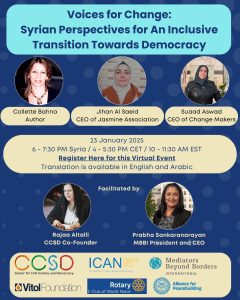
Join speakers Collette Bahna, Author, Jihan Al Saeid, CEO of Jasmine Association, and Suaad Aswad CEO of Change Makers as they share their insights on the future of Syria. This event will be facilitated by Rajaa Altalli, CCSD Co-Founder, and Prabha Sankaranarayan, MBBI President and CEO and will be translated in Arabic and English.
Colette Bahna is a Syrian writer, media personality, and human rights advocate with a diverse and accomplished career. She has authored six books in the field of literature and contributes as a freelance writer to various Arab and international media platforms, including Alhurra. In addition to her literary work, Colette has made a significant impact in the field of drama, having written numerous television series, films, and two theatrical plays. Renowned for her dedication to human rights, she has received several awards recognizing her achievements and contributions. Colette is also an active member of the coordination committee for the “Space for Cooperation” initiative.
Jihan Mahaood Al Saeid is a community advocate with extensive experience in project coordination, education, and psychosocial support. As chairwoman of the Jasmine Association, she oversees impactful initiatives like “Grass of Hope” and “Jasmine Oven,” empowering civil society and supporting displaced communities. With a Sociology degree from Euphrates University, Jihan has facilitated UNICEF and other local international and local-sponsored art exhibitions, awareness campaigns, and educational programs.
Suaad Aswad has extensive experience in advocating for women’s and children’s rights in northwest Syria. She previously served as the Director of the Women and Children’s Affairs Office within local councils, where she played a key role in addressing community needs. From 2019 to 2022, Suaad worked as the Executive Director for the “Hand in Hand We Build Tomorrow” project, which focused on raising awareness about the dangers of child marriage in the region. Currently, she is the Executive Director of the Change Makers Team, an organization dedicated to empowering women and championing their rights in northwest Syria.
Key topics:
- Key challenges from the earthquake two years ago
- Recovery efforts internationally
- Recent regime change’s impact on humanitarian efforts
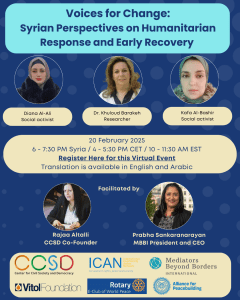
Dr. Khuloud Barakeh, Diana Al-Ali, and Kafa Al Bashir will share their personal experiences, and insights into the needs and expectations of local and international stakeholders. This is a critical opportunity to understand how the recent political developments are shaping humanitarian responses and what can be done to support those in need.
Diana Al-Ali, Director of Souriana Organization, is a community activist and director of the Souriana Organization. Since founding the organization, she has dedicated her efforts to advocating women empowerment whether economically, politically or socially, ensuring they play a vital and influential role in society. Founded in 2018 by a group of activist women, Souriana focuses on humanitarian efforts, peacebuilding, and early recovery, with a special focus on women’s empowerment. Key projects included economic empowerment initiatives, a campaign to assist earthquake-affected communities, and a literacy program for women and girls.
Khuloud Barakeh: Founder, Director of Impact Zone, is a Syrian researcher and academic specializing in education and women’s empowerment, she holds a PhD in Education from the University of Damascus where she later served as an Associate Professor. She has extensive experience in women’s advocacy, co-founding the “Syrian Women for Democracy” coalition and the “Syrian Women for Peace and Democracy” initiative, actively engaging in UN negotiations. Her research focuses on gender-based violence, constitutional gender perspectives, and CEDAW. She also leads Impact Zone, a training and consulting firm, and is a certified trainer in T.O.T. and teacher training.
Kafa Al Bashir is a humanitarian activist and development specialist with expertise in human resources, project management, and monitoring and evaluation. She has led peacebuilding and community initiatives in conflict-affected areas, focusing on women’s empowerment, justice for missing persons, and sustainable development. As Director of the “Permanent Peace for Development” Organization, she oversees projects that improve living conditions and strengthen local communities, with a special emphasis on supporting women in education, health, and economic development.
Key topics:
- Human Rights in Syria
- Activist and Lawyer Perspectives
- Syrians are demanding equal rights and advocating for increased representation and fair policies.
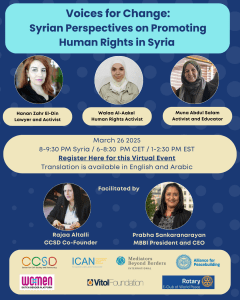
Our speakers Hanan Zahr El-Din, Walaa Al-Akel, Muna Abdul-Salam will assess the current landscape of human rights work, evaluate the challenges and needs, and discuss the role of civil society and international organizations in shaping the future of human rights in Syria.
Hanan Zahr El-Din is a lawyer and human rights activist specializing in international law and human rights, with extensive experience in advocating for women’s rights and reforming discriminatory laws. She has contributed to shadow reports for the CEDAW Committee and helped draft constitutional principles with a gender perspective. She has held leadership roles in several human rights organizations, including the Syrian Women’s Network and “Together for Women’s Issues.” With a background in media, she has written articles on women’s issues and participated in training programs on constitution-building, negotiation, transitional justice, and international humanitarian law. Since 2011, she has been actively engaged in human rights and political activism, striving for justice and democracy in Syria.
Walaa Al-Akel is a human rights advocate with extensive experience in transitional justice, psychosocial support, and human rights documentation. She has worked with various organizations facilitating justice sessions, supporting survivors, and documenting violations. She is a founding member of the Survivors’ Network and plays a dynamic role in civil society leadership. With a diploma in Administrative and Financial Sciences from Damascus University and ongoing studies in engineering, she has completed multiple training programs in psychosocial support, strategic planning, and crisis response. Walaa remains committed to justice, survivor support, and strengthening civil society in Syria.
Muna Abdul-Salam is feminist activist and educator dedicated to women’s empowerment and gender justice. She is the founder and director of Rose Organization for Support and Empowerment and a founding member of Sara Organization for Combating Violence Against Women, where she served as Executive Director and led the legal committee supporting survivors of abuse. Muna has played a key role in organizing and leading initiatives on gender-based violence, child marriage, women’s political participation, and youth life skills. Through her advocacy and leadership, she continues to champion women’s rights and social justice.
Key topics:
- The evolving role of youth in Syria’s political transition
- The challenges they face on the ground
- What it takes to create space for meaningful youth participation in shaping peace and democracy
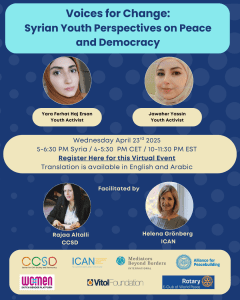
A compelling and timely conversation with courageous Syrian youth activists leading change in their communities. These young changemakers have been at the forefront of civic engagement, advocacy, and peacebuilding efforts across Syria — and now, they’re sharing their stories with the world. Hear their personal reflections on their journeys, bold ideas for a post-conflict Syria, and a vision for a more inclusive, just, and democratic future.
Yara Haj Ersan: Youth Activist Yara is committed to advancing democratic values and civic engagement in Syria. With hands-on experience in the humanitarian and development sectors, she contributes to youth empowerment and democratic resilience. As a participant in a CCSD’s program to strengthen youth-led civil society organizations for sustainable peace, Yara continues to be at the forefront of efforts to create lasting, community-driven change. She facilitated community dialogues, led awareness and advocacy sessions, conducted key informant interviews and focus groups with displaced populations, and coordinated activities that promoted accountability and participation. With a background in Computer Systems Engineering, she blends technical expertise with grassroots activism to foster inclusive spaces where young people can shape their future and drive positive change.
Jawaher Yassin: Youth Activist With a background in chemistry and a deep commitment to social change, Jawaher is a Syrian civic activist with extensive experience in youth and women’s empowerment, community development, and cultural dialogue. She founded Khayzaran Cultural Forum, which promotes social awareness through cultural dialogue.
As a member of the youth cohort at the Center for Civil Society and Democracy (CCSD), she has actively participated in youth forums and peacebuilding workshops. Her work extends to several respected organizations, including where she has led advocacy, project management, and conflict resolution training. Through every role, she remains committed to creating safe, inclusive spaces where young people—especially women—can lead, collaborate, and drive transformative change in their communities.
To read the full summary report, click here.

In the May 21st session of our Voices for Change series, participants gathered to explore valuable lessons from countries that have undergone significant political transitions. The conversation featured Dr. Edita Tahiri, former Deputy Prime Minister of Kosovo, and Dr. Bernadette Muthien, a South African researcher, academic, and poet. Drawing from the histories of Kosovo and South Africa, the speakers offered rich insights into the challenges and breakthroughs in navigating post-conflict recovery and nation-building.
The discussion highlighted the critical roles of women, minority representation, and transitional justice in shaping inclusive societies, encouraging Syrians to reflect on how such global experiences might inform their own journey.
As Syria looks toward a future rooted in justice, equity, and pluralism, the session served as both a source of inspiration and a call to imagine what is possible through resilience, dialogue, and inclusive peacebuilding.
Dr. Edita Tahiri is a prominent leader of Kosovo’s independence movement, with over 30 years of experience in foreign policy, peace negotiations, and post-conflict transitions. She has served in several positions for Kosova, including Deputy Prime Minister, Minister of Foreign Affairs, Minister of Dialogue, and a five-term Member of Parliament. As Kosovo’s Chief Negotiator in the EU-facilitated dialogue with Serbia (2011-2017), she signed the first-ever agreement between Kosovo and Serbia. Dr. Tahiri was the only woman peace negotiator in the Balkans during key international peace processes, including the Rambouillet Conference (1999). She chairs the Regional Women’s Lobby in Southeast Europe (RWLSEE) and is an active member of Women Waging Peace. She is a Fulbright Scholar and speaks Albanian, English, Croatian, Serbian, and Turkish.
Dr. Bernedette Muthien is a Research Fellow in the Office of International Affairs at the University of the Free State. With senior roles in academia, government, and civil society across South Africa and beyond, she is a seasoned researcher, facilitator, and poet. She has over 200 publications and presentations, many translated into 17 languages. A Fulbright-Amy Biehl Fellow at Stanford, she holds advanced degrees in Political Studies from the Universities of Cape Town and Stellenbosch. Bernedette co-founded the African Peace Research and Education Association and serves on multiple international advisory boards focused on peace, security, and cultural rights.

On June 24, the Voices for Change series hosted a powerful conversation on Global Perspectives on Resilience and Transition, featuring two extraordinary peacebuilders: Visaka Dharmadasa, founder of the Association of War Affected Women in Sri Lanka, and Dr. Bilqis Abu-Osba, professor and women’s rights advocate from Yemen.
The discussion was guided by three key themes:
- Lessons learned in national dialogue processes — including do’s and don’ts from Yemen’s National Dialogue and Sri Lanka’s peace efforts;
- The challenges of ensuring women’s inclusion in decision-making — from negotiating ceasefires to shaping political structures;
- The role of international actors — how global engagement can help or hinder locally lead transitions.
This session served as a timely and inspiring reminder of the critical role women play in building peace, challenging systems of exclusion, and driving sustainable transitions.
Guest Speakers
Visaka Dharmadasa is the founder and Chair of the Association of War Affected Women and Parents of Servicemen Missing in Action. A key peacebuilder during Sri Lanka’s civil war, she helped broker the ceasefire between the government and the LTTE and united women across conflict lines. She educates soldiers and leaders on international humanitarian law and promotes UN Resolution 1325 on women, peace, and security. Visaka trains women for political leadership and power sharing, and in 2023 facilitated a historic dialogue between Buddhist monks and the Tamil diaspora, resulting in the six-point Himalaya Declaration. Her work has earned multiple honors, including the 2006 Humanitarian Award from InterAction (Washington D.C.), the 2022 Human Rights Salutation, and the 2024 USIP Women Building Peace Award. A nominee for the 2005 collective Nobel Peace Prize, she has advised the Sri Lankan government and international bodies on reconciliation and human rights. She is affiliated with numerous peace networks, including WASL, GPPAC, and the Global Network of Women Peacebuilders, and holds a Harvard degree in negotiations, mediation, and women’s security.
Dr. Bilqis Abu-Osba is a professor of political science and gender studies at Sana’a University, with extensive experience in government, civil society, and humanitarian work. She served as Vice-President of Yemen’s Supreme National Authority for Combating Corruption and has represented Yemen and Yemeni women at numerous international forums. In 2005, she founded the Awam Cultural Development Foundation to promote women’s political participation. Dr. Abu-Osba has played a key role in establishing networks and alliances advocating for women and youth, particularly during Yemen’s transitional period. During the National Dialogue Conference, she led advocacy campaigns to amplify women’s voices and ensure their presence. She participated in the Kuwait negotiations as one of seven women advocating for inclusion, and in the Sweden consultations as a member of the UN Special Envoy’s Women’s Advisory Group. She was also invited to the signing of the Riyadh Agreement and served on the political committee during the Riyadh consultations. She currently serves as rapporteur of the political committee within the Consultation and Reconciliation Commission supporting the Presidential Leadership Council.
During the September edition of the Voices for Change series, we explored the shared resilience and leadership of Syrian and Afghan women navigating times of profound transition.
Bringing together perspectives from two regions that have faced conflict, upheaval, and shifting political landscapes, this dialogue highlighted how women have mobilized communities, built resilient civil society structures, and drawn on the strength of diaspora networks to sustain hope and drive change.
Our esteemed speakers Palwasha Hassan, Senior Program and Technical Director at Mina’s List, and Sema Nassar, a Syrian human rights researcher and investigator, reflected on the lessons learned from their journeys and the strategies that have enabled them to transform challenges into opportunities for stronger, more inclusive communities.
A full recap summary will be shared soon. Stay tuned!
Sema Nassar is a human rights defender with a focus on detainees and forcibly disappeared persons. Since the early stages of the Syrian conflict, she worked on documenting human rights violations and sexual violence in detention centers. Sema contributed to numerous reports and policy papers on documentation, gender-sensitive accountability, and legislation concerning missing persons, including work with the Conflict and Civicness Research Group at LSE IDEAS. She is a co-founder of multiple initiatives, such as the ‘We’ Network for WHRD in the MENA region and Urnammu for Justice and Human Rights. Sema continues to share her expertise with civic actors and support feminist initiatives in the diaspora, and serves as an investigator with Dar Justice and as a research consultant at the LSE Middle East Centre.
Palwasha Hassan is Senior Technical and Program Director for Mina’s List, overseeing global program implementation. With over 26 years of experience in gender, development, humanitarian aid, and peacebuilding, she has held leadership roles including Executive Director of the Afghan Women’s Educational Center and founding member of the Afghan Women’s Network. She helped establish the women’s quota in Afghanistan’s constitution and launched Roazana, the country’s first women’s legal support organization. Hassan has also facilitated regional dialogues in Pakistan, Iran, and Central Asia to promote human rights, peace, and democracy. A Nobel Peace Prize nominee in 2005, she was a finalist for the Sakharov Prize and received the Hillary
 Voices for Change: The Rule of Law During Political Transition
In October, Voices for Change focused on the role of the rule of law in political transitions, featuring Dr. Jazia Jibril Shaitir from Libya and Dima Mousa from Syria. The discussion explored how justice systems can promote peace, accountability, and democracy in times of upheaval. Speakers highlighted the importance of inclusive political processes, women’s leadership, and trust-building as foundations for lasting stability. Drawing on experiences from Syria and Libya, the session underscored that meaningful participation and strong legal institutions are essential for shaping just and democratic futures.
Dr. Jazia Jibril Shaitir: is an Associate Professor at the Faculty of Law, University of Benghazi, and a prominent legal scholar and activist in criminal law. She has held leadership and advisory roles in academia, contributed to key national legislation including laws on violence against women and national reconciliation, and has extensive experience in legal and security training. Dr. Shaitir has collaborated with international universities and organizations such as Leiden University, UNDP, and ESCWA, and is active in civil society. She has appeared in local media providing legal and human rights analysis and is the author of Legal Reflections: Critical Readings on Libyan Legislation.
Dima Moussa: Damascus-based Syrian lawyer and politician. She holds a bachelor’s degree in electrical engineering and a Juris Doctor, both from the United States, where she practiced law until the end of 2012. Actively engaged in the Syrian political opposition since 2011, she joined the Syrian National Coalition in 2016 and became a founding member of the Syrian Women’s Political Movement in 2017. Moussa was elected Vice President of the Syrian National Coalition in May 2018, serving two consecutive terms until July 2020, and was re-elected in September 2023, a position she held until the fall of the former Syrian regime in December 2024. Currently, she focuses her work on transitional justice, alongside broader issues as a legal expert.
 We concluded this year’s Voices for Change series with an impactful session on Negotiations for an Inclusive Political Transition. The discussion brought together Syrian women leaders and international peacebuilders, including Sawsan Zakzak and Miriam Coronel-Ferrer, to explore challenges and opportunities in inclusive peacebuilding. Participants shared strategies to ensure women’s voices are represented in political processes, navigate cultural and religious dynamics, and advocate for sustainable, gender-sensitive governance. Drawing on experiences from the Philippines, the session highlighted the importance of persistence, collaboration, and pluralist approaches—lessons highly relevant to Syria’s path toward a more inclusive and representative transition.
Sawsan Zakzak: Women’s Rights Advocate and Leader
Sawsan holds a Bachelor’s degree in Arabic Literature and has been a member of the Syrian Women’s League since 1990. She worked as part of the League’s research team on various issues related to Syria, including unpaid work of women, gender-based violence in armed conflict, and discrimination in personal status laws through a comparative study. She also served as Gender Sector Coordinator in the National Agenda for the Future of Syria. She has been a member of the Women’s Advisory Council since 2016.
Mariam Coronel- Ferrer: Peace Negotiator and Scholar
Miriam Coronel-Ferrer is a founding member of the Southeast Asian Women Peace Mediators and former UN Standby Team Mediator, supporting peace efforts in Afghanistan, Iraq, and other countries. She chaired the Philippine government panel that signed the 2014 Comprehensive Agreement on the Bangsamoro, becoming the first woman to lead and sign a major peace accord with a non-state armed group. A retired University of the Philippines professor, she serves on the boards of the International Crisis Group and Interpeace and received the 2015 Hillary Rodham Clinton Award for Advancing Women in Peace and Security.
April 08, 2026
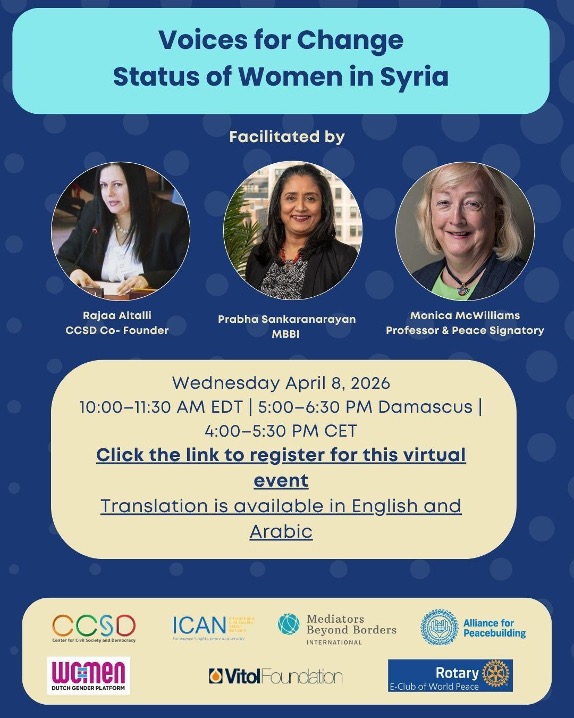 This April, Voices for Change brought together a powerful discussion on women’s leadership and peacebuilding. Rajaa Altalli assessed the status of women in Syria through four key dimensions: Legal Frameworks and Rights, Security and Gender-Based Violence (GBV), Political Participation, and Economic Participation, highlighting both the challenges women face and areas of potential progress. Monica McWilliams contributed her expertise and practical recommendations on how to transform these realities and challenge the culture of discrimination. Their conversation underscored a central message: lasting peace depends on persistence, inclusive dialogue, and the active leadership of women determined to build a more just and equitable society.
Rajaa Altalli is the co-founder of the Center for Civil Society and Democracy (CCSD), where she has been instrumental in shaping the organization’s strategic vision, identifying growth opportunities, and spearheading impactful programming. With over 15 years of expertise in peace, democracy, and security, Rajaa specializes in organizational development within conflict zones and the design of frameworks to enhance institutional productivity. Through her leadership at CCSD, she has consistently championed the participation of women and civil society in political negotiations at both the national and community levels. As a leading strategist in good governance and peacebuilding, Rajaa works closely with the humanitarian and development sectors to drive systemic change. A prominent advocate for inclusive diplomacy, she was a founding member of the Syrian Women’s Advisory Board to the UN Office of the Special Envoy. Her global influence is further reflected in her membership in the Global Peace Builders Summit and the BMW Foundation’s Responsible Leaders Network, where she co-leads the Resource Mobilization Group. An accomplished academic, she holds a Master’s Degree in Applied Mathematics from Northeastern University, earned with a Fulbright Scholarship.
Monica McWilliams is a peace negotiator, academic, and leading advocate for women’s rights and transitional justice in Northern Ireland. She co-founded the Northern Ireland Women’s Coalition in 1996 and was elected to the multi-party peace talks that led to the 1998 Good Friday Agreement, of which she is a signatory. She later served as a Member of the Northern Ireland Legislative Assembly (1998–2003) and as Chief Commissioner of the Northern Ireland Human Rights Commission until 2010, where she contributed to shaping human rights protections, including work on a Bill of Rights. Currently, she is a Commissioner on the Independent Reporting Commission overseeing the disbandment of paramilitary organizations. An Emeritus Professor at Ulster University’s Transitional Justice Institute and a member of the Royal Irish Academy, McWilliams has published extensively on domestic violence and the impact of conflict on women. Her memoir, Stand Up, Speak Out, reflects her lifelong commitment to peace, equality, and justice.
May 20, 2026
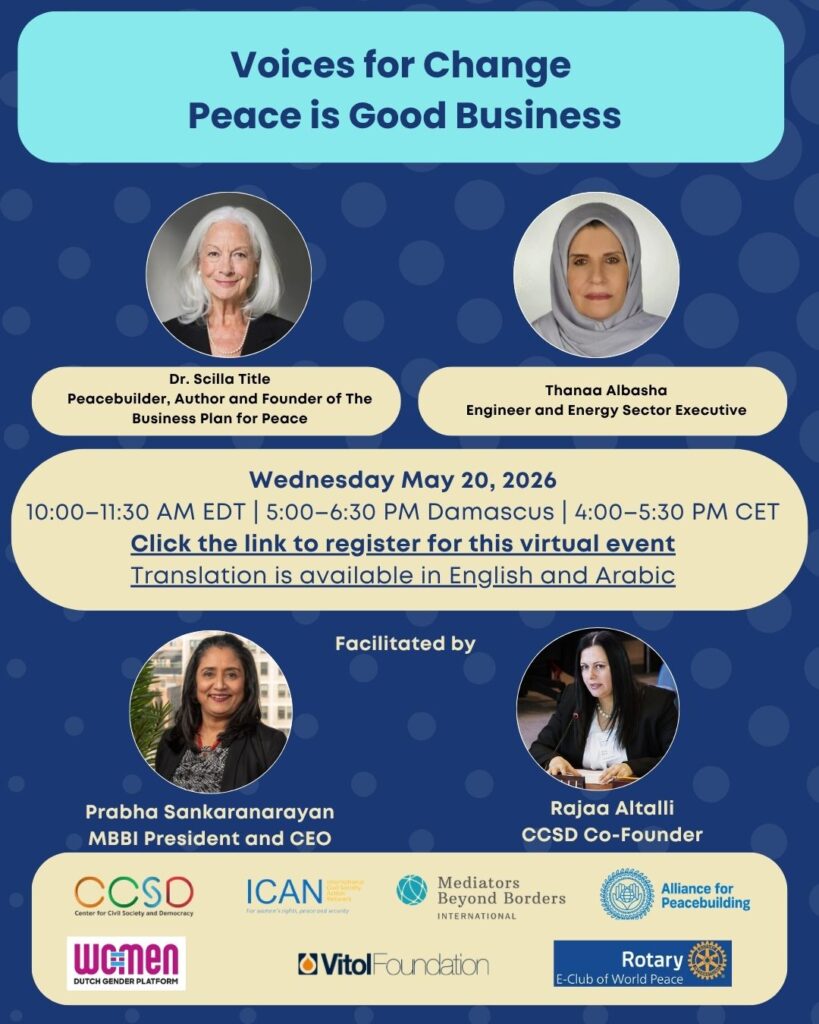 During the May session of Voices for Change, Thanaa Albasha and Dr. Scilla Elworthy explored the vital roles of the private sector, civil society, and local communities in supporting Syria’s post-conflict transition and building sustainable peace. Both speakers emphasized that business leadership must go beyond profit to include social responsibility and civic engagement. Drawing from her experience of regime oppression and asset seizure, Thanaa highlighted the resilience of Syrian entrepreneurs and the need for justice, accountability, and legal reform. Dr. Elworthy stressed the importance of empathy, courage, and dialogue in rebuilding trust and fostering long-term recovery and social cohesion.
Dr. Scilla Elworthy is an internationally renowned peacebuilder, author, and founder of initiatives including Oxford Research Group, Peace Direct, and The Business Plan for Peace. Triple nominated for the Nobel Peace Prize, she has spent decades advancing dialogue, nonviolence, and practical approaches to sustainable peace and conflict prevention worldwide.
Thanaa Al Basha is a mechanical engineer and senior executive with more than 30 years of leadership experience in the energy and construction sectors. She currently serves as General Manager of SAND Holding and Hilti Syria, leading strategic operations and the rehabilitation of war-damaged oil and gas facilities. Throughout her career, she has worked with major global energy companies, including Shell and TotalEnergies, and is recognized for her expertise in managing complex projects, driving sustainable growth, and building effective cross-sector partnerships.
July 8, 2026
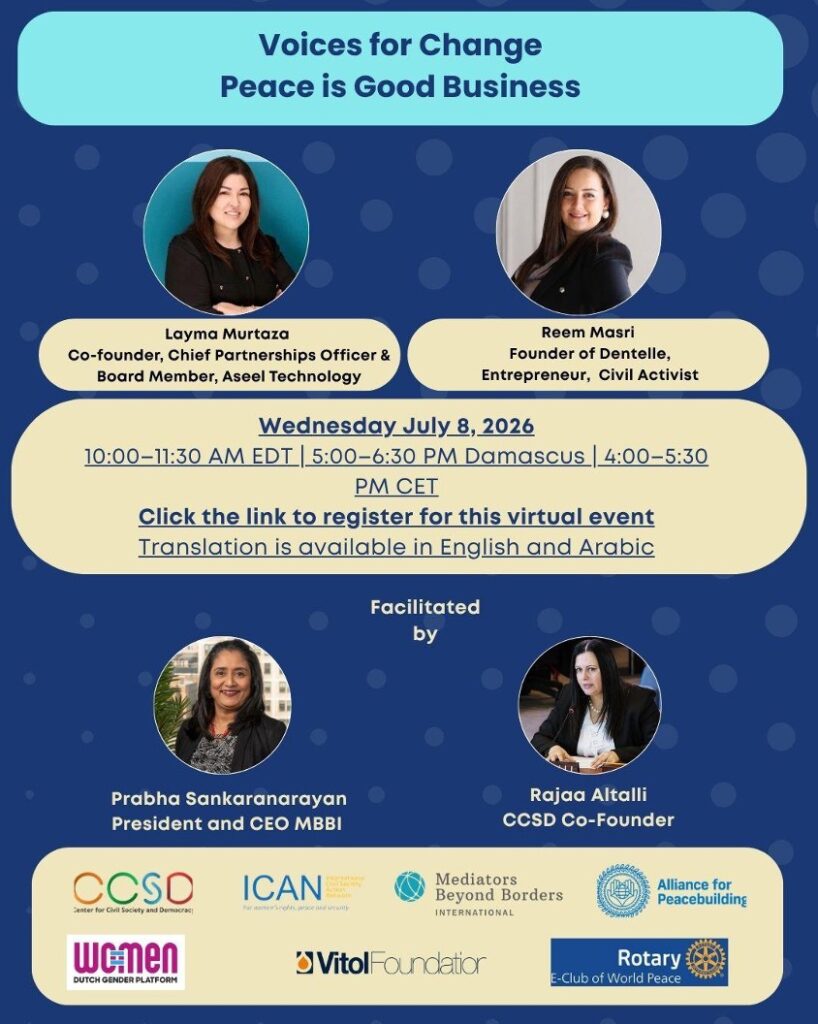 In this session, discussion emphasizes shifting the paradigm in emerging democracies and fragile contexts—such as Syria—from traditional, top-down humanitarian aid dependency to locally led economic development and peacebuilding. Featuring insights from social entrepreneur Reem Masri and tech professional Lema Murtaza, the session highlights how empowering local communities, refugees, and women through entrepreneurship, relationship-building, and digital infrastructure creates sustainable resilience. Reem shares her experience as a Syrian refugee using personal networks and small-scale business models to foster economic empowerment, while Lema explains how financial tech solutions (like ASEEL) bridge digital divides and de-risk mutual aid to enable long-term economic participation. Ultimately, investing in local human capital, transparent economic infrastructure, and inclusive digital tools allows communities to drive their own recovery and sustain peace.
Reem Masri
Entrepreneur, Social Activist, & Economic Empowerment Expert
Reem Masri is a Syrian entrepreneur, researcher, and advocate specializing in women’s economic empowerment, refugee issues, and civic engagement. A University of Aleppo fine arts graduate, she founded Dentelle in Türkiye to expand market access for Syrian women entrepreneurs. Now back in Syria, she manages the Ra’edat Women’s Economic Empowerment Project, consults for the Local Production & Export Development Authority (EPSDA), and leads the Souq Jarat Al-Qala’a initiative. A 2025 Syrian Parliament candidate and U.S. State Department IVLP alumna, Reem champions entrepreneurship as a cornerstone for post-crisis recovery and sustainable peace.
Layma Murtaza
Co-Founder & Chief Partnerships Officer, Aseel Technology
Layma Murtaza is a humanitarian tech entrepreneur and international development expert with over 15 years of experience across the MENA region, Afghanistan, and Türkiye. Her career spans crisis response, state building, and women’s rights, including roles with the Aga Khan Foundation, IRC, DRC, and IOM. She holds master’s degrees from American University and the American University in Cairo, and previously served on the U.S. WPS Committee advocating for Afghan and Syrian women. Today, Layma co-leads Aseel Technology, a D.C.-based platform utilizing locally led tech and AidOS to deliver economic dignity and humanitarian response in conflict-affected regions.
August 19, 2026
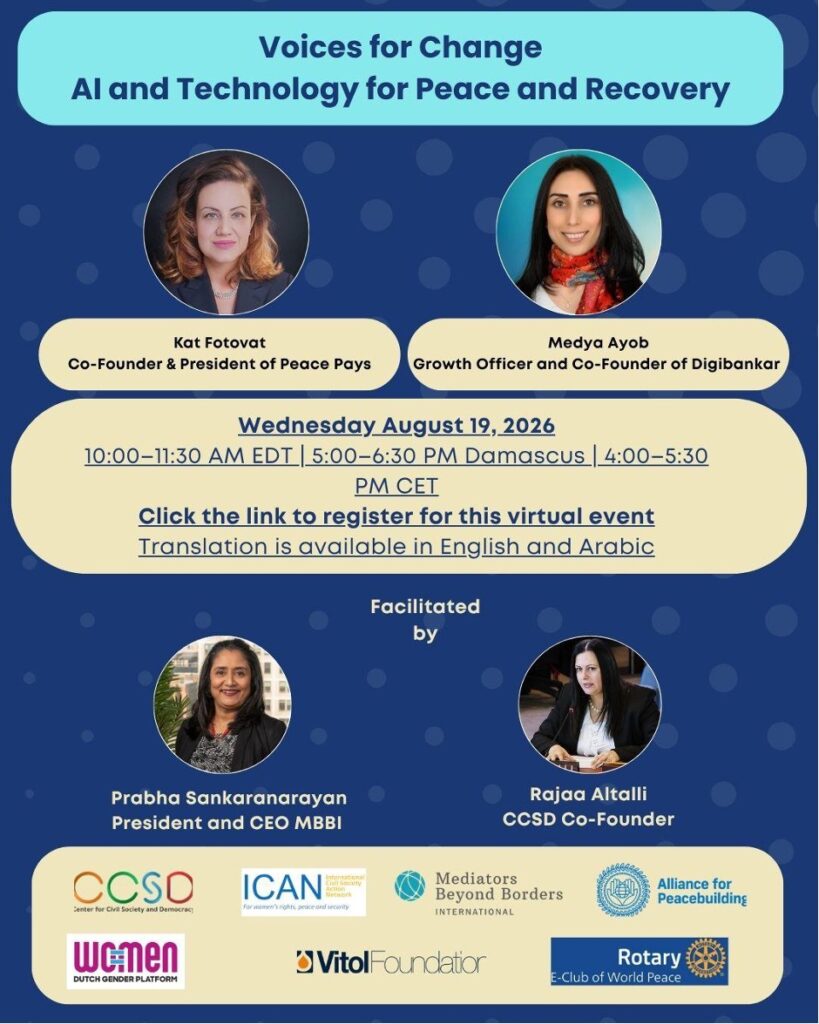 This Voices for Change session explored a timely question: How can AI, technology, and digital finance help shape Syria’s recovery—and who gets to shape the technology itself? Medya Ayob and Kat Fotovat examined the opportunities emerging across reconstruction, peacebuilding, entrepreneurship, financial inclusion, and transitional justice, while addressing the risks of bias, surveillance, disinformation, and exclusion. Drawing on their experiences as entrepreneurs and peacebuilding leaders, they emphasized the importance of local context, lived experience, digital literacy, transparency, and women’s participation in technology and financial decision-making. The conversation also highlighted the role of civil society in connecting communities with donors, governments, and the private sector—and turning local needs into evidence for action. It offered both a practical roadmap and a powerful call to action: Syrian women must claim their place in shaping the technologies that will help define Syria’s future.
Kat Fotovat: Co-Founder & President of Peace Pays
Kat Fotovat is a senior international policy and peacebuilding leader with extensive experience advancing gender equality, human rights, civil society, and inclusive peace and security. She previously served as Acting Ambassador-at-Large in the U.S. Office of Global Women’s Issues, on the White House Gender Policy Council, and as the U.S. Focal Point on Women, Peace, and Security at the United Nations for nearly a decade. She also served as Principal Deputy Director in the Bureau of Democracy, Human Rights, and Labor, overseeing more than $5 billion in programs supporting civil society and human rights, including transitional justice and internet freedom. Her U.S. government career included senior roles at embassies, USAID, and offices focused on conflict, stabilization, and human trafficking. Prior to government service, Fotovat worked with UNHCR, UNICEF, and ABA-CEELI, and contributed to peace negotiations and post-conflict constitution-building with the Nobel Peace Prize-nominated Public International Law & Policy Group (PILPG), where she is currently a Peace Fellow focused on AI and conflict mediation. She also serves as a Senior Advisor to the Swanee Hunt Foundation on Inclusive Security and sits on the board of Afghan Women’s Network International.
Medya Ayob: Digibankar Chief Growth Officer and Co-Founder
Medya Ayob is a language and digital solutions expert with a Master’s degree in Translation and Localization and a Bachelor’s degree in English Literature from the University of Aleppo. She brings over 15 years of experience in translation, localization, and multilingual content management, alongside practical expertise in developing digital solutions and managing complex projects. In 2017, she founded Zomorod Translation and Digital Solutions Group in Türkiye, where she served as Managing Director until 2025. Under her leadership, the company developed an integrated model combining language services, technology solutions, and multilingual content quality assurance. Zomorod provided translation and localization services to international institutions and organizations, including GIZ, IFES, the European Parliament, and Deutsche Welle Akademie, as well as other organizations working in complex and challenging environments. Medya currently continues her work in the technology sector as Co-Founder and Chief Growth Officer at Digibankar, a platform specializing in blockchain-based financial solutions, where she focuses on building partnerships, expanding the platform’s reach, and driving its growth.